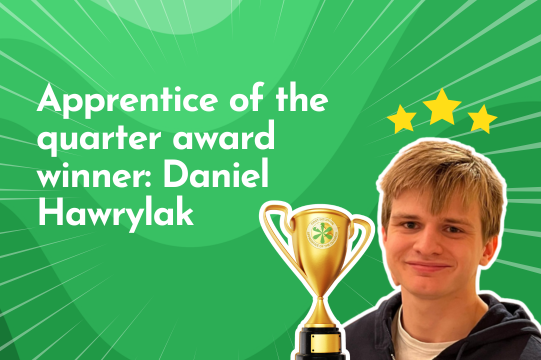
Find out more about Dan’s apprenticeship journey and the advice he’d share with those starting out.
What are you most proud of from your experience to date?
I got 100% on one of my exams! I was so shocked when I found out!
Why would you recommend the apprenticeship route to others?
I would definitely recommend an apprenticeship route. I find it strange saying that now as I initially chose against an apprenticeship as I went to university instead. At university, I had a positive experience and had developed myself a lot throughout the period. However, I always thought I was missing something. I felt that there was too much of focus on essays and coursework at the expense of practical skills. I could write a cracking essay about analytical philosophy, but I would struggle to communicate in front of a group of people. Instead of undertaking a masters, I decided to apply for a job in accountancy. I see it is one of the most supportive industries for people like myself who wish to continue learning outside of academia.
What made you choose a career in accountancy? Was there anything that triggered your decision?
Following from the above, an accountancy apprenticeship gives you dedicated study days to focus on your exams. You also get additional days that focus on developing your soft skills. These are integrated within periods of work. This helps you actually apply the skills you learn to real-world situations.
Many other similar careers in finance that don’t have apprenticeships offer little-to-no support. If school leavers or graduates wish to develop and improve themselves, they are expected to use their personal time.
How did you approach your studies and what resources/support that FI offer did you find most useful? Do you have any study tips for other apprentices starting their studies?
I found the exams I performed the best on where the ones where I jumped into practice questions as soon as possible. Reading from a textbook can give you core knowledge, but exam success is much more related to the application of knowledge and the evaluation of information. The best way to improve these skills is to do practice questions.
I found the mock exams offered by FI to be one of the biggest factors in my exam success. The written exams are marked by a real person who will give you timely feedback on your performance. This gives you a strong indicator of where you are at with each exam and how much additional time and effort is needed to achieve a pass mark. They can also be great at directing you towards areas that you are weakest at.
How do you manage juggling work and study?
The best piece of advice is to work smarter not harder with revision. A lot of apprentices fall into the trap of thinking that more revision means better exam performance. This is true to a certain extent, but the quality of revision is, in my view, much more important and often neglected.
A huge way to improve your “quality” of revision is to understand the science of learning. Understanding how the brain processes new information can in the long run massively boost the efficiency of your study. I would draw attention to “cognitive overload” as a clear example.
As you get deeper into your revision sessions, your attention drops and your brain feels exhausted. This results in diminishing learning returns. It is much more time efficient to revise in short regular bursts rather than cramming revision all in the end.
As you shift your priorities towards quality over quantity of revision, juggling work and study becomes significantly easier.
How have you been supported by your company and colleagues throughout your apprenticeship so far? How has this contributed to your success with both your qualification and adding value to Barnes Roffe?
Barnes Roffe have been a great supporter of me throughout my apprenticeship. I found that Barnes Roffe has given me the opportunity to apply the skills I have learnt throughout the apprenticeship. At larger firms, accountancy work is much more specialised and niche. An auditor at a top four firm could spend months testing just sales, for example. At Barnes Roffe, we are exposed to an array of areas of audit and accountancy in a short period of time. We can complete a full audit file, draft the accounts and prepare the corporation tax within a few weeks. This gives us a lot of real-world exposure to the content we learn in the exams.
What are your goals/plans for when you finish your apprenticeship?
No plans yet. Maybe a nice holiday immediately after though!
Congratulations again, Dan, for this massive achievement, and thank you for letting us interview you.
ICAEW Qualification Previous Apprentice of the Quarter Interviews