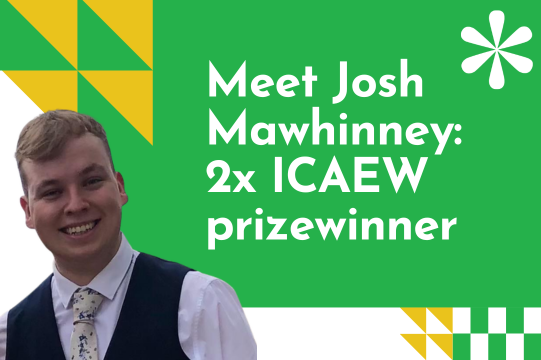
From consistent preparation to a highly tailored approach to revision. Hear from ICAEW apprentice, Josh, on how he focused on question practice, learning from mistakes, and building strong exam technique, while balancing rest and support from those around him.
Congratulations on becoming a two-time prizewinner, earning two of the most prestigious ICAEW awards. How did you feel receiving the awards?
Thank you very much, I am delighted to receive both prizes from the ICAEW, it was a very welcome surprise! My initial reaction was a mix of excitement and a bit of shock, but above all, I felt incredibly proud to be recognised for my performance across the Professional Level. The most important thing to me across all the exams was simply to be as well prepared as possible and perform to the best of my ability on the day, so receiving the prizes was a fantastic bonus.
What do you believe were the key factors behind your success?
I did put a lot of time and effort into my preparation for the exams. I was determined to succeed and wanted to do the best that I could possibly do, so there are a few key factors I think contributed to my success. First, I would start my exam preparation the week after tuition finished, which was roughly around 8 weeks before the exam date. I think revising sooner and having longevity as opposed to relying on cramming in the last few weeks was particularly important. I wanted to be in a position where I felt I could attempt the exams as I arrived for the revision phase of the course.
I didn’t necessarily have a very detailed revision schedule; I tried to utilise my weekends compared to weekday evenings as I felt fresher and more productive. I did try to do some revision every weeknight, but if I was in a busy period with work, such as month or quarter end, I would make sure that my rest was prioritised to avoid burnout.
The final key factor was building a support network during the qualification; this made a huge difference. The encouragement and advice I received from my fiancée, family and colleagues helped me stay motivated and resilient throughout the qualification.
What motivated you to pursue a career in accountancy and choose the apprenticeship route?
Growing up, I was always interested in roles that involved problem-solving and working with numbers, which initially drew me towards both finance and engineering. During school and college, I sought out opportunities to help guide which path I should follow, such as work experience and conversations with professionals in the industry. Following this, I decided that accountancy seemed to best fit for me.
During my third year of university, I secured a placement role at Bupa within the Operations Finance team in the UK Care Services business unit, which I thoroughly enjoyed. It gave me valuable insight into working in finance within a large organisation and confirmed that this was the career path I wanted to pursue. Through conversations with other graduates, I learned more about the ACA qualification and the Level 7 apprenticeship, and the opportunity to work full-time while studying towards a professional qualification equivalent to a master’s degree really appealed to me. It felt like the ideal way to combine practical experience with structured learning, which made the apprenticeship route a natural choice.
You scored the highest marks globally across all six Professional Level exams in a year. What study techniques or strategies helped you the most in securing such outstanding results?
As mentioned before, I think starting early is key. I would begin my exam preparation shortly after tuition finished, and work through the revision preparation phases in FI Learn. This consists of video debriefs on how to answer several question bank questions across a variety of key areas in the exam. This was very useful, and it was important to do this from the outset to understand the key methods, techniques, and ensure I knew what good looked like. I also spent time familiarising myself with the textbook so I knew where to quickly find key information that commonly appeared in questions.
I didn’t use revision cards as I don’t find them too useful personally. Instead, I stuck post-it notes around my monitor with concepts that didn’t click initially, or I had missed more than once. Seeing these regularly during the day really helped to recall the missed points and made sure I didn’t miss them again. Similarly, I didn’t do closed-book question practice, as again, the more I saw something, the easier it was to recall. The only closed-book practice I did was the mock exams, as well as the questions in my revision classes.
I also kept an Excel file where, after I answered the question bank questions, I would highlight trickier questions to revisit or any areas I missed on my first attempt. This made it easier to focus my revision more efficiently. The final point is also making sure I spend time resting and getting out of the house. I would revise in maximum two-hour blocks before taking a short break away from my screen. This helped me stay refreshed and clear-headed throughout the exam period.
During your ICAEW qualification, you’ve had access to both classroom learning and some FI Online courses. Which study method worked best for you? And what tips would you share with other students aiming for ICAEW prize-winner status?
Personally, I found the classroom learning to be better for me. I enjoy being amongst peers. It made it easier to have group conversations around the lesson’s content, as well as sharing with each other what has been working well and what hasn’t when revising, so I was able to learn from different approaches. It’s also great for building networks with the other peers and tutors, which again helped to build my support network.
However, I did also enjoy the online learning. I was pleasantly surprised at how interactive the sessions were at First Intuition compared to other learning experiences I’ve had elsewhere. The Adobe platform used is fantastic.
I think the key tip from me to other students is to find what works best for you. Keep a good level of consistency with revision, and use all resources available to you, including the textbooks, videos, and tutors.
How have you been supported by your Bupa and colleagues throughout your studies? How has this contributed to your success with ICAEW so far?
The support I have received from my colleagues at Bupa has been instrumental to my success so far with the ICAEW qualification. I’ve been very fortunate to work with managers, mentors, and colleagues who have taken time to ensure they check in regarding my studies progress and offer their support and advice from their own experiences. My colleagues have been incredibly caring and accommodating, and I am very grateful to everyone who has supported me so far!
I think I may be a slightly less common example of somebody who has been working in industry rather than practice during my studies. The Finance and Governance graduate scheme I am a part of is designed to offer three 12-month rotations, so by the time you have completed the scheme, you have experience in a variety of roles across Bupa’s BGIUK market unit and Group. I’ve completed rotations in the BGIUK Control Function and Group Financial Planning and Analysis, and I am currently positioned in Group Financial Reporting. Each role has tied in well with my studies, for example, the Control Function tied in well with my Assurance and AA papers, FP&A with the strategy papers, such as BST and SBM papers, and FRT with FAR and CR papers.
In addition, the Early Careers team have also supported my apprenticeship through additional training linked to the apprenticeship key knowledge, skills, and behaviours. I recently attended one of our Graduate Development Days alongside our actuarial, legal, and business management graduates and placement students, which is great to support network building across the business. Overall, this combination of practical experience, structured support and a collaborative culture has played a key role in my progress and success so far.
How did First Intuition’s support contribute to your preparation and prizewinner performance in your exams?
First of all, a big thank you to all my tutors at First Intuition who have helped support me during the qualification so far. All my tutors have been incredibly approachable, willing to answer any questions I have, and have taken the time to make sure I fully understood the answers they provided, both inside and outside of working classroom hours.
The structure of the courses across the Professional Level worked well for me. Initially, attending the tuition phases of the courses helped to introduce the key concepts and theories in each paper. The course then has breaks in between tuition and revision, where I am able to consolidate the information I have been taught in tuition and make sure any areas I initially found difficult can be revisited. The revision phase for me was the most valuable. It was quality time to make sure my exam technique and concepts were nailed by practising question bank questions, followed by full tutor debriefs to assess where answers could be improved.
During the courses, I sat 4 mock exams. One at the end of tuition, a self-marked ‘gap’ mock in between tuition and revision, one at the start of revision, and one at the end of revision. These were incredibly useful, as when I entered each exam, it felt a lot more natural doing the exam in exam conditions and under timed conditions, as I had done this at least 4 times previously. This approach overall definitely played a key role in my preparation and ultimately contributed significantly to my performance in the exams.
You’ve already achieved so much within your apprenticeship. Do you have any goals/plans in mind for when you finish your ICAEW qualification?
Yes definitely! Once I complete my qualification, my main goal is to continue building a strong career in this profession. I’ve been fortunate so far to experience a wide variety of roles across Financial Reporting, Financial Planning and Analysis, the Control Function, and Operations Finance. Therefore, I want to focus on transitioning into a role where I can continue to develop my key knowledge, skills and behaviours, continue to learn from and be guided by experienced colleagues, and look forward to taking on greater responsibility over time and seeing where this takes me.
Outside of work, there’s plenty to look forward to as well. My fiancée and I bought our first home together last year, so spending some more time renovating and decorating. We’re getting married later this year, too, so there’s lots to look forward to both professionally and personally!
Once again, a huge congratulations on your success, Josh. We wish you the best of luck in the future.
ICAEW Programmes Lauren, ICAEW prizewinner
How to become an ICAEW prizewinner